Marine TETRA
The standard the emergency services use.
TETRA is a trunked digital standard built for services that cannot afford a failed call. On a superyacht it brings fast call setup, strong encryption, reliable group calling and data alongside voice. OLAS is the only DAMM Authorised System Partner in the superyacht industry.
Why TETRA on a Yacht
What crews notice first is the sound. TETRA voice is crystal clear, with none of the interference, crackle and crosstalk of analogue radio, so a message is heard the first time, even in a noisy engine room.
TETRA was designed for mission-critical use. Call setup is fast enough that pressing the button and speaking works as an instinct rather than a procedure. Encryption is built into the standard rather than added to it. Group calls behave predictably under load, which matters when an incident puts every handset on the same talkgroup at once.
It also carries data properly. Status messages, text, telemetry and position all ride the same infrastructure as the voice, which is what allows a radio to become an alerting device rather than only a talking one.
TETRA or DMR?
Broadly: TETRA for faster call setup, stronger encryption, better group-call handling under load and mission-critical resilience; DMR for lower cost, simpler infrastructure and a wider handset choice. Vessel size, crew count and how much the operation depends on the radio decide it, not a preference for one standard.
We specify both, and being vendor-agnostic means the recommendation follows the vessel. The full comparison — including DMR Tier 2 versus Tier 3, and when a DMR system can be migrated to TETRA later — is on our marine DMR page.
The DAMM Partnership, and TCCA Membership
OLAS is the only DAMM Authorised System Partner in the superyacht industry. DAMM is a world leader in TETRA and DMR infrastructure, and authorised-partner status means direct access to the platform, its engineering support and its roadmap.
OLAS is also a member of TCCA, the Critical Communications Association — the international body behind the TETRA standard and the wider critical-communications ecosystem. Membership keeps our engineering aligned with the standard itself rather than with any one vendor's interpretation of it.
Both sit alongside our vendor-agnostic approach rather than against it. Impartiality about handsets and surrounding equipment is more useful, not less, when the infrastructure underneath is a platform we know to its foundations and a standard we help steward.
Coverage Is the Hard Part
A TETRA system is only as good as the coverage carrying it. On a large hull that means a distributed antenna system designed from an RF survey, with coverage heatmapped in design and measured on commissioning.
We treat the radio system and the coverage as one piece of engineering, because a specification that ignores the hull produces a system that works on the sun deck and nowhere else.
One platform, four technologies
The DAMM platform carries TETRA, TEDS, DMR Tier III and analogue on the same base station, so a vessel is not locked to the standard it starts with. Indoor and outdoor base stations mesh together, and the terminal gateway, packet data gateway and open API are how the radio system connects to everything else onboard — dispatch, alarm and monitoring systems, telephony and logging.
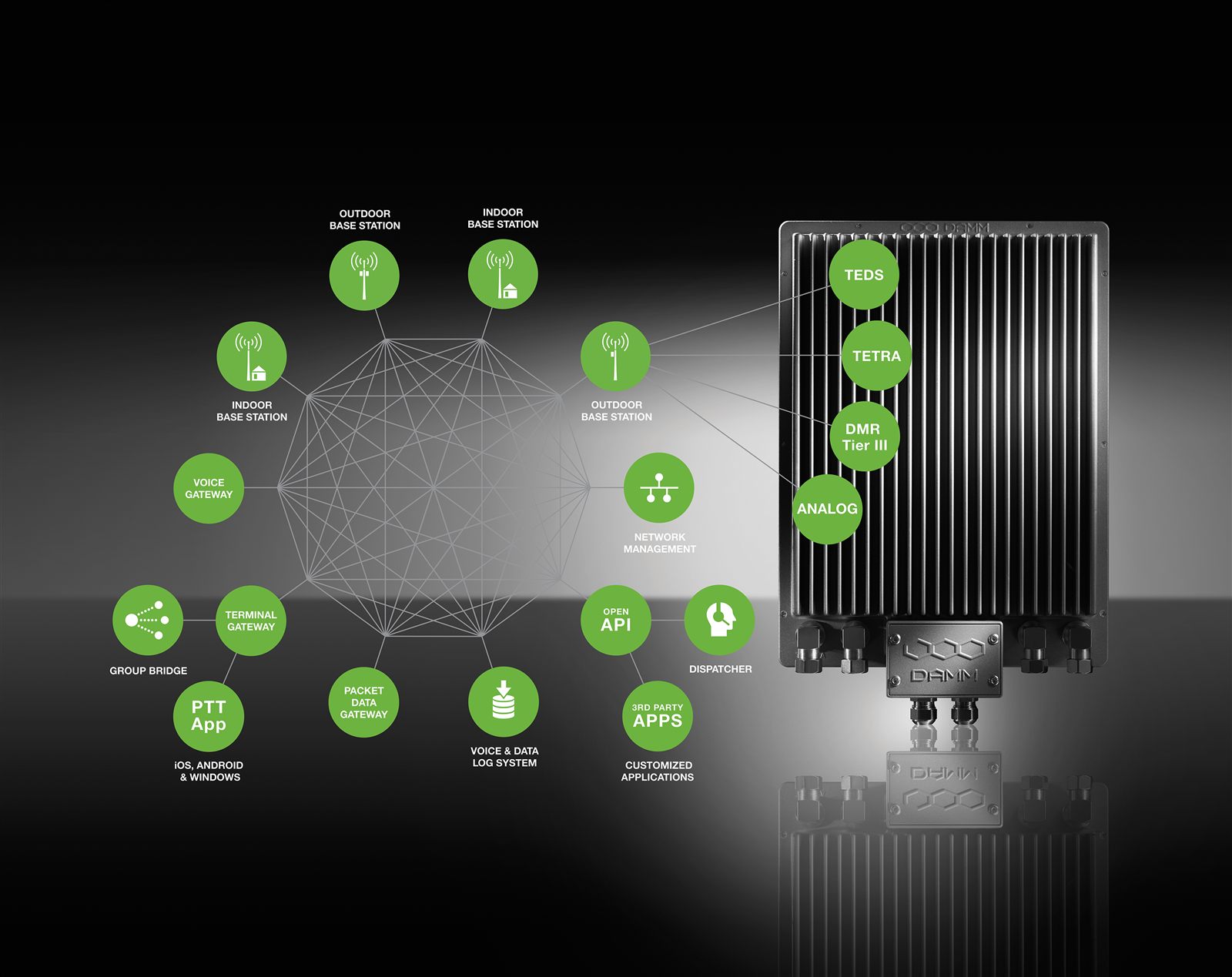
That open API is the difference between a radio fleet and a communication system: it is what lets an alarm on the vessel reach the right handset, and what lets a dispatcher see who answered.
The only DAMM Authorised System Partner in the superyacht industry, and a member of TCCA — the international body behind the TETRA standard.
Clear Voice in a Noisy Offshore Environment
DAMM's comparison of radio technologies in a genuinely noisy offshore setting. Digital voice with active noise reduction strips machinery and wind noise out of the transmission, so the message arrives clear rather than merely loud.
Marine TETRA — common questions
DMR is lower cost with simpler infrastructure and suits smaller crews. TETRA offers faster call setup, stronger encryption, better group-call handling and true mission-critical resilience, which is why it dominates on larger yachts and commercial vessels. Vessel size, crew count and operational dependence on the radio decide which is appropriate.
Yes. TETRA carries data alongside voice, so alarm and monitoring systems, service-call points and telephone systems can raise messages directly to crew handsets. The available scope depends on the systems already fitted onboard.
Direct access to DAMM's TETRA and DMR infrastructure, its engineering support and its roadmap. OLAS is the only such partner in the superyacht industry, which means the platform underneath a system we design is one we support to its foundations rather than resell.
Often, and the cabling is usually the reusable part. A survey establishes what the existing coverage infrastructure can carry: the cabling frequently survives a migration, while the antennas, handsets and infrastructure change.
We're here to help.
Talk to one of our specialist team about Marine TETRA. Call us, email us, or send a message with the form and we will reply as quickly as possible.